Electric
Vehicle TERMS & ABBREVIATIONS
How Do
You Charge an Electric Vehicle?
How far do
EV's go on a Charge
How Much Do
EV's Cost?
THE TRUTH ABOUT BATTERIES
THE BAD NEWS FOR CAR DEALERSHIPS
How
Much Can You Save Driving an EV?
What is a
NEV?
What
is a Green Village?
What
Maintenance is Required?
What
Kind of Batteries are Used?
How Do You
Convert a Standard Vehicle to EV?
How Do
You Purchase an EV?
What is a "Hybrid" Electric Vehicle?
What is a "Hydro" Electric Vehicle?
References & Books
Fuel
to Metric World Conversion
Calculator
TERMS & ABBREVIATIONS:
AFV
Alternate Fuel
Vehicle - Generally a car that runs
entirely or partially using a form of propulsion
other than or along with a gas/fossil fuel
combustion engine.
BEV - Battery electric vehicle. Cars that obtain their power primarily from batteries which are recharged by solar or conventional electric sources.
CASH CAPTURING MACHINE - ElectricCars.com coined slang name for a gasoline fuel pump.
CHARGE LINE
- A power cord which connects an EV to it's
transformer for the purpose of recharging.
(Automated charge lines which will require no
effort on the part of the driver to connect will
become reality someday)
ELECTRIC CONVERSION - Process of replacing a gasoline powered engine with an electric motor & battery pack.
ENGINE - Device that converts matter into motion. As with vehicles usually burning or igniting (See Motor).
EV / EC
Electric Vehicle /
Electric Car - An automobile that uses
an electric motor either to propel it or to aid in
producing power which directly propels it.
GAS HOG VEHICLES - ElectricCars.com 2003 Any vehicle that huge and is driven by someone who does not require it's massive size. Usually found on highways commuting one 140 pound human miles to work or sticking annoyingly out parking spaces designed for "normal vehicles".
GAS STARVATION - ElectricCars.com coined slang name for gas shortages steamed by runs on supplies. These began to occur in the mid 2015's.
GREEN STREETS - ElectricCars.com 2001 Any area, zone or street in a city designated specifically limiting vehicle to lower "safer" speeds. Thus making smaller cars, especially electric NEV's and LSV's more practical and safe to drive.
GREEN
VILLAGE -
Greenstreets - Westwind/Trinity Project
Any city or town designed specifically
to be a "Clean Environment" including
limiting modes of transportation (usually for smaller cars), layout of shopping,
residences,etc
"STANDARD" HYBRID CAR - Vehicles that use an electric motor along with both separately and simultaneoulsy with another type of power source and/or motor.
LSV - Low
speed vehicle - Typically judged by governments to
include cars that have top speeds between 20 - 25
MPH.
MOTOR - Device that converts energy into motion. As with electric vehicles usually by using eletricity induced magnetic opposition and attraction. For decades people referred to the motor in their automotbiles but this was incorrect. Gas "engines" are in gas cars. (See Engine) .
NEV - Neighborhood electric vehicle Car that is normally smaller than most and restricted to lower speeds (usually 25 MPH) to conform with goverment issued safety mandates.
NHTSA -
National Highway and Traffic Safety Administration.
US government agency in charge of regulating the
construction of vehicles to meet standards of
safety.
PHEV - Plug in hybrid electric vehicle. Cars that are are equipped with both an electric battery and a gas-powered engine
PHOTO
VOLTAIC - A unit that uses solar
technology to generate electric power.
PHOTO VOLTAIC PAINT - Future advanced automotive paint that recharge an EV by generating electric power directly from the sun.
PLUG IN HYBRID CAR - Vehicles that use an electric motor along with another type of motor but differ from "standard hybrid cars" in that you plug the car into a power source to recharge the batteries. The car usually runs off the electric power and motor until it needs the other motor as a "backup" power.
SG Hybrid - Self generating hybrid car (also called a series hybrid) that has an onboard energy generation unit (usually gas powered) to recharge itself.
SOLAR CHARGE
UNIT - A system which uses a bank of
photo voltaic cells and a processing unit to make
electric power and manage the recharging of
EV's.
SHOWROOM SHARKS -
Unscrupulous car salemen known to prey on customers and use
unethical practices to sell cars.
ESUV
Electric Sport Utility
Vehicle - Including but not limited to 4
wheel drive vehicles generally driven by people who
want to dispose of as much fossil fuel as
possible.
RANGE -
Distance an EV will go before recharging is
necessary.
RECHARGE -
Process of replenishing electric power stored in
onboard batteries.
REGENERATIVE
- Process of recharging a power system by the use
of a secondary generator - IE Many EV's engage a
generator each time you hit the brakes thus
expanding your range before recharge by using
energy that is normally lost.
SELF GENERATING HYBRID CAR - Vehicles that use an electric motor along but differ from "standard hybrid cars" the car uses another source of electricity (usually a gas powered generator) to recharge its batteries.
V2G Vehicle to Grid - Electric car with power generation unit (usually solar) that while not in use produces energy that is induced into the public power system.
return
to top
How
Do You Recharge?
A modern
battery pack requires 3 to 6 hours to recharge.
Upgraged charging systems reduce the time to full charge dramatically. This technology is improving every year and we
foresee many advances coming soon. Including EV's
that are painted with photovoltaic paints to
capture electricity from the sun and systems that
use onboard alternate engines to recharge the
batteries and cover you when your batteries are
depleted.
Most EVs have
on-board standard 110 - 220 volt chargers, and major
cities around the world are making public charge
units available for next to no cost. Many are
provided free to EV users to influence more people
to use this clean means of transportation.
Most owners
report a monthly expense of about $3 to recharge
their EV. The important thing to remember is charging systems that use your home electricity systems will be phased out in coming years. Electric cars will eventually be charged from solar energy eliminating fuel costs completely!
return
to top
How Far do EV's Go on a Single
Charge?
EV Ranges are
increasing every year. Today most EV's are designed
to go 100 to 400 miles on a single
charge. Predictions are that EV's will go more
than 1000 miles by the year 2030.
70% of drivers in cities drive less than 25 miles
per day; 90% drive less than 50 miles per day. Half of all
urban trips are less than 5 miles. The
average urban car trip is less than 10 minutes;
measured in time, Electric cars have ranges that exceed typical city
driving distances of less than 30 minutes. The majority of
us could meet our daily transportation requirements
in an EV with mileage to spare!
Some early PHEV's and Hybrids have onboard charging systems that use a standard gas powered motor to run a generator. These gave their drivers a peace of mind knowing they could drive all the way across the country without running out of charge. Realistically, most people never need that type of range and those systems ran into problems when people filled their Dinosaur "gas fuel tanks" and never used the gas! The gas separated and caused their gas generators to fail.
return
to top
How Much Do EV"s Cost?
Some of the early electric cars like the General Motors EV-1 were subsodised to sell at "normal gas car prices" of around
$30,000. Manufacturers lost money on these cars and usually made their customers agree to give the cars back at the end of costly lease payment programs.
Thankfully those days are over!
A typical "practical" electric car will cost from $40,000 on up. Some of the more powerful fancy sports car electrics can cost hundreds of thousands!
When buying an electric car you should factor in the money you will not spend on gas. So, if your car buying decision comes down to a gas burner that costs $25,000 and an electric that costs $40,000 you have to consider not having to pay $20,000 to $50,000 over the lifetime of the gas car. So, really, buying a "more expensive" electric car still makes more sense money wise.
THE TRUTH ABOUT BATTERIES!
Batteries are going to follow in the foot steps of calculators and computers. The first models were expensive, and technologies improved drastically! Computers in the 1990's are relics. Today's computers we own are more powerful than the ones that sent our Apollo rockets to the moon!
You will probably want to replace your electric car's batteries in the 5th to 10th year of owning it.This is expensive but battery technology in the near future will be even better giving you longer ranges, shorter charging times, etc. So, money-wise an electric car will probably cost close to the same as buying a less exensive gas burmer. But, you're saving the planet, you're helping us all live longer, breathe cleaner air, etc.
Today almost
every major car company in the world is planning to phase out gas cars in the next 5-10 years.
Many
different EV models are available ranging from "on
street carts" in the $5,000 to $7,000 price range,
Stylish Coupes and useful small trucks ranging from
$15,000 to $25,000 on up to specialized "head
turning" EV's that cost above $30K.
With the increasing number of
electric cars being produced the average cost per unit
is decreasing at am impressive rate. In 2004 GM only
made a very small number of EV-1's so they were expensive. If they had
made the same number of Corvettes the average price
of a Corvette would have been over $150,
000.. Now every major car company is begining to mass produce electric cars.
Hey! there is good news though... see "THE BAD NEWS FOR CAR DEALERSHIPS" to see how electric cars will still save you thousands of dollars!
return
to top
THE BAD NEWS FOR CAR DEALERSHIPS!
We hate to deliver bad news for car dealerships. And this will cause massive losses income for all of them.
Electric cars will only require a FRACTION of maintenace over their life-spans.
This is very bad news for the thousands of car dealerships around the world!
Sorry!
But, the days of driving "X" amount of miles and having to spend "X" thousands on tune-ups, oil changes, timing belts, fuel injection systems etc etc etc ARE OVER!!!
Most people who have owned gas cars know the pain of having a auto mechanic give them "the bad news". Repairs for gas cars were HORRIBLE! In the 1950s to 2000's gas motors only went about 80,000 miles before major repairs hit the car owner hard. Rebuilding a gas motor, where they had to remove it from the car, machine the internal components, reasseble it, cost anywhere from $3,000 to $10,000 and up!
You think a broken arm hurts... How about looking in your rear view mirror and seeing smoke spewing from your car...Your transmission failed... That was another $4,000 to $8,000... Then there were thos tune-ups... on some cars they literally had to PULL THE MOTOR OUT OF THE CAR to replace $3 dollar spark plugs.
OUCH!
The repair bills we all paid made car dealerships sickenly wealthy... By the 2010's gas cars had become so technologically "advanced" car dealers were forced to invest millions of dollars in tech systems to work on them. Those costs were transfered to the customers who paid $80 to $250 per hour for the dealerships "labor costs".
This is another reason the gas car industry fought electric cars in the 1990's and 2000's. They knew electric cars, with fewer moving parts would not feed their service department incomes.
Times have changed. Dealerships will still do well for decades because their are about a billion gas cars on the planet... Of course we're also working on Electric Conversions... ( Watch our project ElectricConversions )
Typical electric car Maintenance?
Most sealed
deep-cycle batteries require little or no
maintenance. Tires, brakes and suspension,
are on par with most any vehicle. Some EV's
boast to require no tune-ups, oil changes,
coolants, mufflers, emission tests, etc. In
fact, the biggest hassle you may encounter owning
an Electric Vehicle is convincing DMV that you
don't need a smog test!
Electric
motors are expected to last over a million
miles!. Electric motor have very few moving
parts compared to an internal combustion engine
which has hundreds. Electric connections will need
to be checked for corrosion about every 3 years...
You will tell your wife "Honey, will make a note
for me to check the EV after the next
olympics!
return
to top
What is an NEV "Neighborhood Electric
Vehicle?
On June 17,
1998 a major breakthrough occurred in the NEV
market as the National Highway Traffic Safety
Administration (NHTSA) created a new class of motor
vehicle, the Low-Speed/Neighborhood Electric
Vehicle (NEV). - Developed to meet the public's
demand for local area transportation and decrease
the unnecessary waste of energy used by single
passengers on short trips.
The average
trip in a vehicle is less than 3 miles and it makes
much more sense to not have to fire up a gas
powered vehicle weighing thousands of pounds if you
only want to go to your corner store.
This new
category of motor vehicles has catapulted EV's into
the forefront of alternative transportation. EV's
offer safe transportation while addressing the
significant issues facing our planet today, from
urban sprawl to air pollution.
NHTSA
requirements to qualify as a low-speed vehicle are
that the vehicle must be equipped with automotive
safety glass windshield, turn signals, mirrors,
wiper blades, head and tail lights, and
seatbelts.
|
One
of the first NEV's produced was the GEM
CAR which was originally launched in 1992
by a group of former General Motors
Engineers in Livonia, Michigan. Mike
Hofer, a North Dakota Businessman
assembled a group of investors, purchased
and moved the company to Fargo, ND in
December, 1997. In April of 1998, the
factory produced its first vehicle, a
2-passenger 48-volt vehicle with a top
speed of 20 mph.. 1998 saw the production
of 480 vehicles. By June of 1999, monthly
production had reached over 100 per month
with total production in 1999 being 1826
vehicles. June of 2000 saw production
reach 500 vehicles per month with a total
production for the year of over 5000
vehicles.
|
return
to top
What is our "Green Streets"
project
Some people
envision a place to live where asphalt does not
cover the beautiful natural earth. These areas within cities where only low emission NEVs are allowed are called "Green Streets". Entire towns where only electric cars are allowed are called "Green Villages" But, to be realistic we don't foresee entire cities going electric for quite some time.
With smaller electric cars your neighborhood becomes a place where
you can ride your bike anywhere you want to go
without being run off the road by large cars
traveling at high speeds and fearing for your life. Parking smaller cars is easy. Noise from traffic is reduced and traffic congestion is less because more of these smaller cars can fit per square foot of pavement.
In 1990 the
founder of ElectricCars.com began to plan a
place called Westwind / Trinity and
plans to make this ideal community a reality in the
future. Plans include lush green surroundings,
pathways to walk everywhere you want to go, and "Autopaths" for you to ride in small open air
vehicles to your job, school, home or nearby stores
etc.
Larger "Long
distance" transportation is located aboave and
under the ground and links residences to the outer
word.
THE SLOGAN FOR GREEN STREETS:
"You don't need a 4,000 pound car to carry 10 pounds of groceries"

return
to top
What Kind of Batteries are Used?
During the dark ages
(Pre 2010) electric cars were still weighed down by the same massive
Lead Acid batteries like the batteries used in World War II.
Early NEV's had 6V, "golf-cart" deep-cycle batteries
required less stowage space and can last 3 to 5
years. Standard model electric cars used 8, 12 or more 12V deep-cycle batteries that required still only provided ranges of 50-100 miles before charging. People wanted these big bulky batteries in their cars to provide a full
bank of power to get them through the
day.
Even worse lead acid batteries failed in about the 3rd year. Most power
packs had to be replaced
for a cost of $300 to $700 dollars. And, lead acid batteries had to be filled with water, and kept at full charge or they would fail even sooner!
Yikes. Those "Lead Acid" days sucked!
Lead-acid
technology was the only affordable choice at this
time.
However, today we have newer battery technologies like lithium-ion nickel cadmium, nickel metal-hydride
and even better technologies coming in the next 5-10 years.
Hydrogen fuel cells were another type of electric car energy system but the truth was oil companies knew their gas revenues would dwindle as electric cars took over so they wanted to find another commoditiy they could sell car owners. We rejected using H-fuel systems in cars because in reality all it would do would make car owners pay for "H" instead of "G".
Batteries today, and newer batteries will be virtually maintenance-free and
promise to last over a decade before replacement is
required. We predict the only time people will want to reaplace their batteries in the future will be to have 1,000 plus mile ranges... 10 minute recharge times, etc. It's possible some of todays batteries will outlive your car!
Many people
feel that the large auto manufacturers are still holding
up advances in battery technologies and EV developments
because it is "not profitable to produce a product
that requires no maintenance". But the public is
demanding cheaper, cleaner and more environmentally
safe means of transportation. Demand will drive the market.
return
to top
How Do You Convert a Standard
Car?
Many
companies are emerging around the world that
specialize in removing standard engines, gas tanks
and replacing them with EV powerplants. In general,
you will want to select a smaller car to start
with. Weight is a vital factor, and it is not wise
to select a car which has low storage capacity
being that conversion require truck space for the
batteries. Some models that we have been impressed
with are porsche's, Vette's, and even vintage Model
T's...
We're
building an online database of companiees that do "Electric Conversions" and have even created a
separate category for the Constuction and
Conversion of Electric Vehicles.
return
to top
How Do You Buy an Electric
Vehicle?
All of the major auto manufacturers are selling fully electric cars. Watch our showroom!
Things will
get better! Just a few short years from now the
world will be phasing out combustible engines
completely as we are depleting our oil reserves and
the costs of fuels increase.
We were the
first website in the world to make a 100%
commitment to Electric Vehicles and today we are
building our Dealers
Section
by including basically ANY auto dealership that
shows a commitment to providing quality EV's to the
public.
We Need
Your Help! Please tell your local dealer that
you are an EV customer and have them contact us if
they feature EV's in their stock.
return
to top
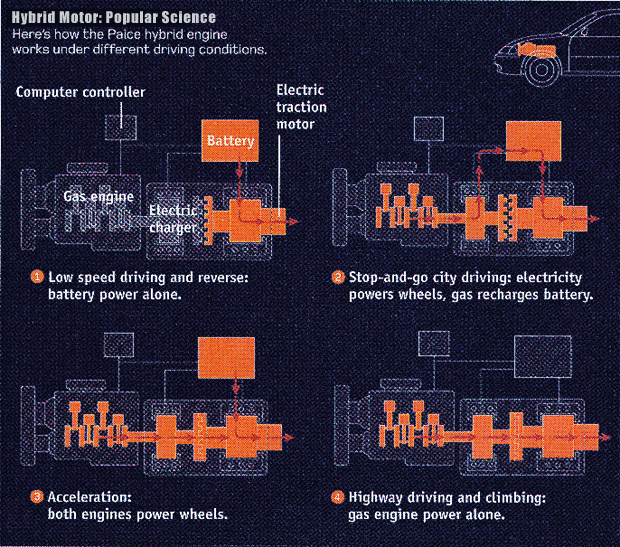
What is a "Hybrid" Electric Vehicle?
In the early "0's" manufacturers of AFV's are still faced with
one problem... How to produce an AFV that will go
as far once "Filled up/charged" as a gas powered
car. Battery technologies have made huge advances
but still can not retain enough energy to push an
EV over 200 miles. (Most gas powered cars are
designed to have a 300-500 mile range per
tank)
The
Solution "Use the Best of Both Worlds!" The
logical step for EV makers at this time is to use a
small gas engine along with an electric motor. When
the car is in idle or negotiating city driving & low speed accelerations the EMotor will
economically be in control of the car. (Emotors are
very good at starts, Stops and slow speeds) Then,
once the EMotor has gotten the car up to cruising
speeds the GMotor will kick in and propel the car.
(GMotors generally operate more efficiently at
cruising speeds)
Wait, It
gets Better! The number one concern of EV
buyers is "How do I charge the car up?". Hybrids
cured this problem in an ingenious way... Since
most GMotors cruise along and have extra horses to
spare at normal driving speeds the hybrid EV will
actually "flip a switch", (unknown by the driver)
and kick in a small generator that CHARGES THE
BATTERIES!.
At this dark
time during the early "0's" companies have still
not developed roof top solar stations and
automatic charge links so people are worried
they will not be able to plug their EV's charge
line into their AC outlets when they park the car.
This is a process that takes approximately 10
seconds to do but, after a busy day even this can
be a grueling task.
The
average stop into a gas station takes 7 minutes,
involves paying an attendant or debiting your bank
account and given certain conditions may involve
danger, adverse weather conditions and
inconvenience... Now consider taking 10 seconds to
plug your EV's charge line in when you get home at
night.
These "Hybrid" vehicles boasted incredible economy &
longer ranges between charges. Some as much as 90
miles per gallon! (At the time 40mpg was considered
"economical")
Future
Advances? GMotors will be completely phased out
as EMotors are becoming more energy efficient
AND batteries are getting small, cheaper & easier to charge.
Click Here to Read
this FAQ Hybrid
Cars
return
to top
What is a "Hydro" Electric
Vehicle?
Scientists
have devised an ingenious device that uses raw
hydrogen to generate electric power. This
technology was used way back in the 1970-80's by
NASA as a power source for the Apollo Moon
Missions. The only byproduct of this hyrdo chemical
conversion is pure water. Sounds good? Read
on....
Don't Let
them Make Us All "Jump from the Fryer into the
Pan!" The fact is, petroleum companies know the
earth's oil reserves like all natural resources
will eventually be exhausted. When you combine
diminishing supplies with greed, stock/profit
motivations and monopoly markets we all know some
time in the next 50 to 100 years gas prices will
skyrocket. (One of the major causes of the "great
recession of 2002" was high gas prices)
"Hydro Electric
Power produces water as a byproduct... Yes, this is
correct
when you see your monthly hydro costs you're gonna
shed a tear sure!"
So a simple
chemical machine that produces electricity sounds
attractive. But really, when you think about it the
petro companies are just changing our thirst for
gas into "A thirst for Hydrogen". They propose
spending BILLIONS OF DOLLARS to convert gas
stations all over the world into Hydro Stations.
Who
will end up paying for the costly conversions of
gasoline stations.... You Will
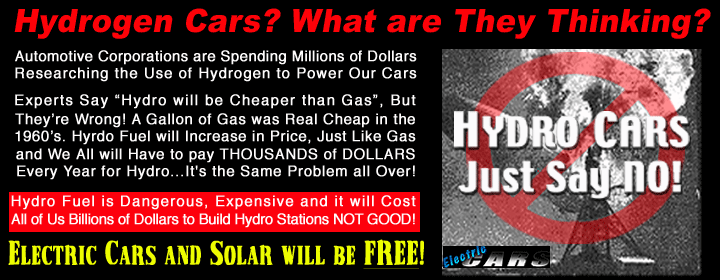
Stop!
We all have a clean source of power within 10 feet
of our faces... If you are on a computer look at
the wall... There's enough clean, cheap electricity
available at your wall outlet to power an electric
car. Better yet, in the near future that wall
outlet will be hooked up to solar panels on your
roof. Your car will be powered by FREE electric
power generated from the sun. (Which is in
itself a "Hydrogen Powered Fuel Source" that
creates more power per millisecond than humans will
ever need!)
Electric Cars
promise to eliminate our yearly gas bills
100% by 2020 Prices of Hyrdo power will continue
to increase over time much like gasoline did.
Hydrogen is a man-made commodity like oil and
water... In the 1960's you could drive into a
gasoline station, pay less than 50 cents for a
gallon of gas, have an attendant pump the gas for
you, check your oil and clean your windshield...
Now, we pay $1.50 to $4.00 per gallon and you're
lucky the attendant even acknowledges your
existance!
PHOTO: The
Hindenberg was a hydrogen filled blimp, and the
world's first transatlantic "lighter than air"
craft. Built in Germany in the 1920-40's Blimps
were said to be "The safest means of
transportation". While landing on it's maiden
voyage to the United States the Hindenberg's crew
strung a tether line down to the awaiting ground
crew which was intended to be used as a pull rope
to bring the massive vehicle to a safe docking...
At that moment the vessel burst into flames with a
violent and deadly explosion.
It is
presumed that an electric charge was generated due
to negative ions caused by air friction (much like
the spark you get when you touch a door knob after
walking on carpet) However, at the time the world
was under political pressures after world war I and
many people believed the Hindenberg was blown up by
the Americans to send a message to Germany... A
world war almost broke out because a couple
scientists forgot about static electricity...
return
to top
EV Books Recommended
Hackleman,
Michael. The New Electric Vehicle--A Clean
And Quiet Revolution, Home Power, 1996.
(A good survey of the great variety of EVs,
especially the more exotic and
experimental.)
Brant,
Bob. Build Your Own Electric
Vehicle. Tab Books, 1994. (An
excellent introduction to the subject. However, despite the title, the book is about
converting, not really building.)
Schiffer,
Michael Brian. Taking Charge: The Electric
Automobile in America. Smithsonian, 1994. (A
wonderful social history of the electric car and
its place in the culture.)
Wakefield,
Ernest H. History of the Electric Automobile
SAE International, 1994. (Full of interesting if
little known facts, though somewhat poorly
written.)
return
to top
|
